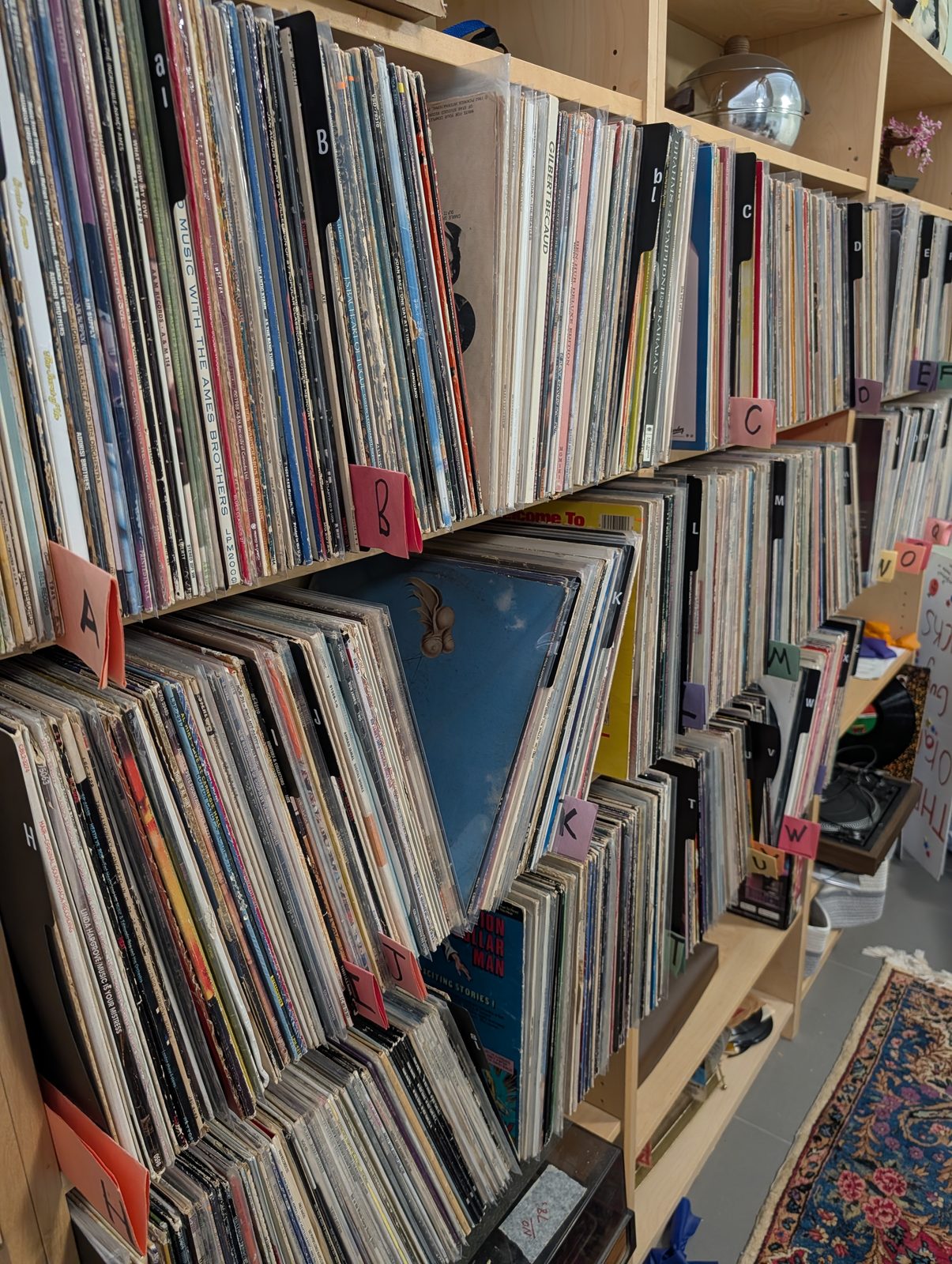
The racks at Oliver's — nearly every record here came out of a collection somebody once built one album at a time.
Inherited a basement full of LPs? Downsizing the shelves you spent thirty years filling? I buy record collections — big ones, small ones, and the box you're not sure about. Fairly graded, honestly priced, and handled by someone who will actually play them.
I come to you, anywhere on the Peninsula — Palo Alto, Menlo Park, Los Altos, Mountain View, Redwood City and the towns either side.
Email Oliver → How it works
The racks at Oliver's — nearly every record here came out of a collection somebody once built one album at a time.
No forms, no lowball bots, no "we buy anything" van. Three steps, and you deal with me the whole way.
A rough count, a few phone photos of the spines, and anything you know about where the records came from. That's genuinely all I need to start.
I research every pressing the way I'd want mine treated — deadwax, labels, the works. You'll know what you have before you decide anything.
One number, explained. Take it, sleep on it, or shop it around — no pressure either way. If a collection deserves more than I can pay, I'll tell you that too.
The honest version, so you don't waste a trip.
I used to be an overnight rock DJ — the guy playing full album sides at 2am for whoever was still out there listening. These days I run this store with help from my daughter, grading and cleaning every record by hand and writing up each pressing like it matters. Because it does.
What that means for you: I don't weigh collections by the pound. The record that's worth real money gets identified and you get paid for it — even when you didn't know it was in the box. That's the whole deal, and it's why most of my collections come from referrals.
Based on the San Francisco Peninsula. Happy to look at collections anywhere in the Bay Area — and for the right shelf of records, I've been known to drive.
You don't have to box up four hundred records and drive them over a hill. For anything past a crate or two, I come to the collection. That's the whole point — records travel badly, and the ones worth money travel worst.
I'm based in Palo Alto. These are the towns I get to regularly, and where "near me" actually means me:
If your town isn't on that list, write anyway. The list is where I go without thinking about it, not a fence. For the right shelf of records I've been known to drive a good deal further.
A lot of the collections I buy belonged to someone who died. That's usually how a wall of records ends up being somebody else's problem, on a deadline, in a house that has to be emptied by a date on a calendar.
A few things worth knowing before anyone starts carrying boxes to the curb.
Don't throw out the sleeves. A record with no jacket is worth a fraction of the same record with one, and the jacket is the part that looks disposable. Same for the paper inner sleeves, which are sometimes how a first pressing gets identified at all.
Don't sort them. Whatever order they're in is information. Somebody built that shelf over decades, and how it's arranged tells me things about what I'm looking at.
Don't clean them. Well-meant cleaning does more damage than thirty years of dust. I have an ultrasonic tank for exactly this and it can wait until they're mine.
And the honest part: most inherited collections are not secretly worth a fortune. The average shelf of records is worth real but modest money. I'll tell you which it is, in writing, and if it's the kind of collection that deserves an auction house rather than me, I'll say that instead of quietly buying it cheap.
I do, and for most of the Peninsula I'll come to the house. There are real counters within driving distance — The Record Man on El Camino in Redwood City and Vinyl Solution in San Mateo among them — and if you'd rather hand records across a desk, go and see them. The difference isn't distance, it's the direction of travel: a shop needs you to box the collection and carry it in, which is a lot of lifting to do before anyone has told you what any of it is worth. I come to the records instead.
Honestly, it depends on things you can't see from across the room — the pressing, the deadwax, the condition of the vinyl rather than the cover. Two copies of the same album that look identical on a shelf can be worth $8 and $300. That's not a dodge, it's the actual answer, and it's why I research every record before I give you a number instead of quoting by the crate. If you want to know how I judge condition before you talk to me, here's exactly how I grade records.
No. Please don't. Photograph the spines right where they sit and leave everything else alone.
That's normal and it costs you nothing. Most people selling me a collection didn't build it. You don't need to know what a first pressing is — that's my job, and I'll tell you what you had after I've looked.
No. You get one number with the reasoning attached. Take it, sleep on it, or shop it around. If a collection deserves more than I can pay, I'll tell you that too — I'd rather lose a purchase than buy something under what it's worth from someone who didn't know.
I research each pressing the way I'd want mine treated. Deadwax, labels, catalogue numbers, and what that exact pressing in that exact condition actually sells for — not what a price guide printed in 2004 says it might. Then you get one number, explained, so you can see which records carried it.
45s and box sets, yes, especially when they travelled with the LPs. 78s are heavy, fragile and a much smaller market, so I'm choosier — but bring them up rather than assuming.
Water damage, records with scratches you can feel with a fingernail, big-box classical and easy-listening sets, and modern repressings of records that exist as originals. I'd rather say that here than in your living room.