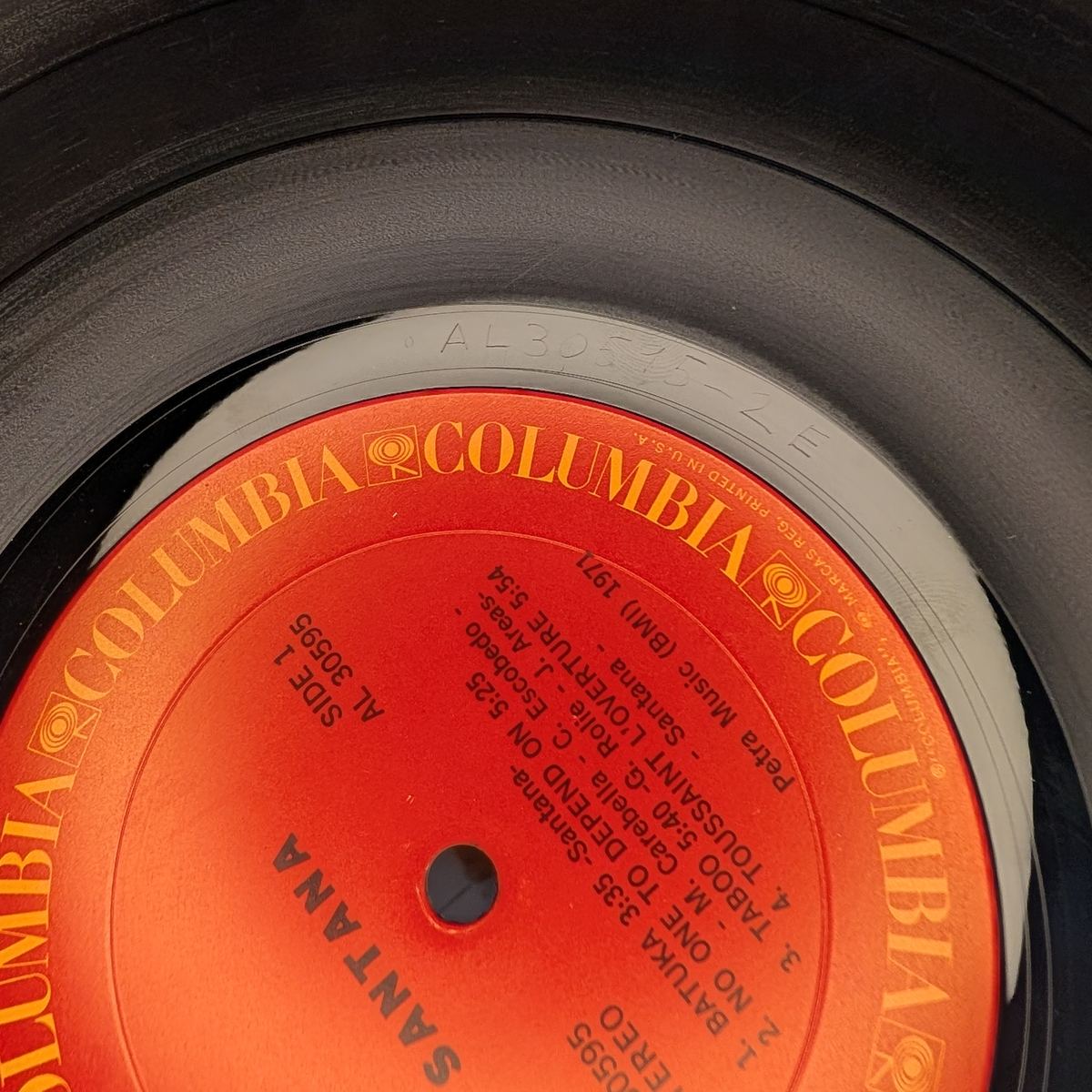
In September I found two copies of Santana's 1971 album sitting in my store at $194.99 and $205.99. They'd been there since May.
It's the one most people call Santana III. Columbia KC 30595. It's a great record, and it's everywhere. On Discogs, 15,413 people own a copy, and that week 187 were for sale starting at a dollar. On eBay there were more than 240 copies listed, and the middle of the pack was asking $15.
I was asking thirteen times that.
Nobody had bought them, and nobody was going to. Record buyers know. A price like that doesn't just sit there, either. It tells every collector who scrolls past that the seller doesn't know what he has. That one stung.
Both came down to $14.99, and one sold less than three weeks later, for $12.74. Then I spent a lot longer fixing how I price. Here's where I landed, the whole method, numbers included.
The suggested price was the problem
Both prices came out of my listing tool, and my listing tool trusted Discogs' suggested price. Discogs will tell sellers what a record should go for in each grade. By September it said $61.18 in VG+ for that Santana, still about four times the middle eBay ask, and asks already run high.
When I lined those suggestions up across a batch, the pattern was hard to miss. Near Mint was always VG+ times 1.307. Mint was always VG+ times 1.461. Every release, same curve. And the VG+ number underneath could be wild on common records. It said $110 for a standard copy of Thriller. It said $97 for a Donny Osmond record with copies for sale from $1.54.
What a record actually sells for
Discogs keeps the real number too. It's just not the one it hands you first. Every release page has a Statistics box with Low, Median and High, worked out from the last 30 copies of that release that actually sold. When I checked Thriller in July, the median was $23.99, not $110.
That median is where I start now. The word doing all the work is sold.
What an asking price really is
This is the mistake I see most. Someone googles their record, finds one listed at $300, and decides that's what theirs is worth.
That listing is somebody's hope. Anyone can type any number into a listing, and search results mostly show you what's still for sale. Think about which copies those are. The fairly priced ones sold and disappeared. The ones still sitting there are, more often than not, priced like my Santana was.
One ask is a wish. Two hundred asks for the same pressing, with the dreamers trimmed off, is at least the outline of a market.
I'll be straight with you, I look at what's listed too. When there aren't enough sales to go on, I scan the live listings for the same pressing, skip my own (otherwise a bad price of mine ends up vouching for itself), ignore the dreamers, and treat the middle as a ceiling, never a target.
The pressing is the price
Most of a record's value lives somewhere most people never look. The dead wax is the smooth band between the last song and the label, and it's where the matrix number is etched or stamped. It's how you tell a $15 reissue from a $150 original wearing the same cover.
It cuts the other way too. When I checked comps for Traffic's Heaven Is in Your Mind, the middle came back at $89.88. The expensive ones were Sundazed's mono reissue. The original 1968 United Artists pressings were going for $40 to $50. Sometimes the reissue is the dearer record, and you only find out by checking which pressing every comp is.
And sometimes there's no market at all. Exactly one person on Discogs owns a copy of Quilapayún's X Viet-Nam, and nobody was selling one. Few comps usually means rare, not overpriced. I left mine at $403.99.
Grade, then whatever came with it
Once I've got a real number for the right pressing, the grade moves it. This is what I multiply by.
That drop from VG+ to VG is steep on purpose. VG is where you start to hear the record's life story between the songs. If you're not sure which one you've got, here's how I grade.
Then the extras that belong to this particular copy, not the pressing. A signature is worth 50% more. The original poster, 40%. An obi strip on a Japanese pressing, 35%. Original shrink, 15%. A Japanese lyric insert, 10%. A hype sticker, an insert or the original inner sleeve, 8%. Only the biggest one counts. They don't stack. A signed copy with its inner sleeve is a signed copy.
Then the shelf price
Last, how it goes up on eBay. Working from real sales, the auction opens at 75% of that number and Buy It Now sits right at it. eBay wants a Buy It Now at least 30% above the opening bid, so I keep it 35% clear, which sometimes nudges it up a dollar. Everything ends in .99 because that's how everybody does it, and I'm not above it.
Say it's a VG+ Thriller with its original inner sleeve
- Discogs median, last 30 sales, July 2026
- $23.99
- VG+
- × 1.00 = $23.99
- Original inner sleeve
- × 1.08 = $25.91
- Auction opens at 75%, rounded up to .99
- $19.99
- Buy It Now, 35% clear of the opening bid
- $26.99
$25.91 would round up to a $25.99 Buy It Now, but that's less than 35% over $19.99, so it nudges up to $26.99.
My floor is $9.99 to open an auction and $14.99 for Buy It Now. If the math lands under that, the floor wins.
My shipping is calculated: what the post office charges for the weight, plus $1.50 handling per order, and it's free on orders of $24.99 or more. I don't hide margin in it. When I compare against other sellers, I add their shipping to their price. A $4.99 record with $12 shipping is a $16.99 record.
Try it on your own records
What's your record really worth?
I built a free price check that walks through all of this. It reads your dead wax, points you at the right sales on Discogs and eBay, and does the math in the open. It doesn't show you anyone's prices. It sends you to where they live, and you bring the numbers back.
Check your recordAnd if you're holding a box of these from a parent's house, that's my favorite email to get. Here's how I buy collections.
If you try it and something doesn't add up, tell me. I'd rather hear it from you than from a record that's been sitting for six months.